Recently Tāmaki Paenga Hira Auckland Museum acquired a collection of vintage shoes from shoe designer and retailer Douglas Clarence George. Curator of Social History, Jane Groufsky, shares with us the story behind this well-known figure in the late 20th century queer Auckland scene, and how his shoes had a starring role in the short film Naughty Little Peeptoe 

Pictured below: Shoes from the Doug George collection 

The selection of shoes seen here comes from the collection of shoe designer and retailer Douglas Clarence George. George grew up in Manurewa, later moving to Christchurch where he began working in a shoe shop at the age of 18. In Australia, George developed his own shoe brand “Georgia D” (a gender reversal of his own name) and worked with two factories there to supply stores such as David Jones. After 12 years there he moved back to Auckland where he opened a Georgia D shoe store in Khartoum Place. George made simple, classic women’s shoes and even expanded into larger sizes to supply his drag queen clientele. George was HIV positive when he returned to New Zealand, and he passed away in 1994. 
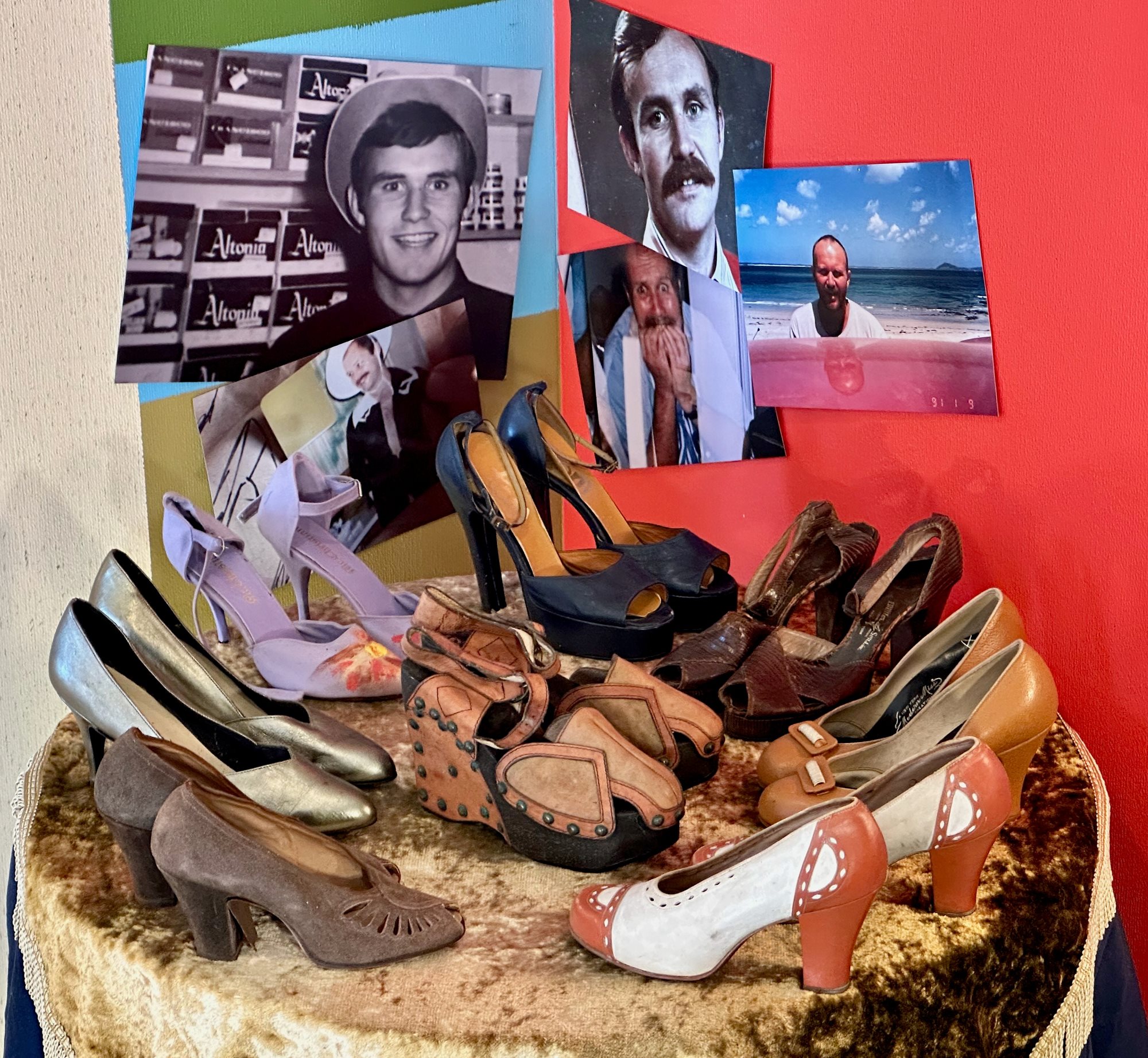
Doug George and shoes from his collection. Image courtesy of Garth Maxwell 
 George's collection of around 40 pairs of vintage shoes was amassed throughout his career, with many of them on display in a cabinet in his store. Although the shoes in this collection are typical examples of 20th-century women’s footwear, their significance comes from their association with George, a well-known figure in the late 20th century queer Auckland scene, and from their starring role in the short film Naughty Little Peeptoe directed by Garth Maxwell and Peter Wells and released in 2000.

Still from the short film Naughty Little Peeptoe directed by Garth Maxwell & Peter Wells and released in 2000. Reproduced courtesy of MF Films Ltd 

Naughty Little Peeptoe is formed around an interview with George conducted by Maxwell and author Debra Daley shortly before George died. In the recording, George talks candidly about his upbringing in Manurewa, his relationships with his parents, his queer identity, and how his life with shoes was intertwined with these memories. He recalls, as a child, seeing women in movies being passionately kissed by men, and how he speculated that if his mother would only wear fabulous shoes instead of gumboots then she too might be kissed by his father (something George only witnessed once).

 He talks explicitly about the connection between shoes and sex, and the posture created by high heels - "...what happens is when women wear shoes that are high, with platforms and what have you, is that their posture changes...They go up, their buttocks go in, their thighs slim down, their shoulders go back, their busts go out, their backs get a curvature in them. So they look sexy.” 

Shoes, Mr Christian, 1980s. Made in Australia. Collection of Auckland Museum Tāmaki Paenga Hira, 2025.17.1, Gift of Garth Maxwell

More information ›

Shoes, Georgia D, circa 1994. Made in New Zealand. Collection of Auckland Museum Tāmaki Paenga Hira, 2025.17.1, Gift of Garth Maxwell

More information ›

Shoes, I. Miller & Sons, 1940s. Made in New York. Collection of Auckland Museum Tāmaki Paenga Hira, 2025.17.2, Gift of Garth Maxwell

More information ›

Shoes from the Doug George collection

Throughout the film, Maxwell and Wells illustrate this narration with photographs from George’s life and with shots of shoes in his collection. These are intercut with scenes of dancer and choreographer Taiaroa Royal dancing in high heels and a corset, occasionally draped in gossamer cloth; and of young men (marchers from the Hero parade) athletically larking about on St Leonards Beach (at the time known as a gay/nudist beach) with Rangitoto in the background, balancing the shoe collection on their bodies. Maxwell reflected on George’s narration, “He reached imaginative conclusions about what shoes did for women, to their posture and to create a sense of identity, and he explained these ideas in vivid language, to our delight. In our recording, he referenced individual shoes from the collection he had built up throughout his professional life. He was that special combination of a master technician who knew all aspects of shoe construction, design and history, but brought to that his charming salesman’s appreciation of what each shoe offered.” 

Stills from the short film “Naughty Little Peeptoe” directed by Garth Maxwell & Peter Wells and released in 2000. Reproduced courtesy of MF Films Ltd

“Naughty Little Peeptoe” was screened as part of the 2024 NZ International Film Festival and last year was acquired into the Museum of Modern Art’s film collection where it featured in their “Queer and Uncensored” film series in May 2025, a major survey of queer film and video. Senior film curator Ron Magliozzi says of the film, "Naughty Little Peeptoe honors its subject’s fulfilling commitment to fetish and offers witty testimony to the durable, liberating spirit of a queer perspective.” The shoes in the film are George’s enduring co-stars and now the collection lives on in Auckland Museum, maintaining George’s legacy. 

“Naughty Little Peeptoe” can be streamed through AroVision on demand

Watch


Shoes from the Doug George collection